Monday, February 4, 2019

Is God Love?

As 1 John 4:16 proclaims, “God is love, and whoever abides in love abides in God, and God abides in him.” For some Christians and other theists, the idea that “God is love” encompasses their entire theology.[1] For example, adherents of the recent “I hate religion but love Jesus” movement tend to consider God to be their loving father and Jesus their best friend, while disassociating themselves from organized religion.[2] However, is God really “love?” After having read the Bible cover to cover some years back, I am perplexed that anyone could come to that conclusion. The truth is, while the Bible tends to praise God for his loving nature, his actions indicate he is nothing more than a tyrant.
 
The Old Testament God
The “God is love” crowd tends to point to passages such as the following to support the notion that the Old Testament God was compassionate:
 
  • “But it is because the Lord loves you and is keeping the oath that he swore to your fathers, that the Lord has brought you out with a mighty hand and redeemed you from the house of slavery, from the hand of Pharaoh king of Egypt” (Deuteronomy 7:8).
  • “The Lord, the Lord, a God merciful and gracious, slow to anger, and abounding in steadfast love and faithfulness, keeping steadfast love for thousands, forgiving iniquity and transgression and sin” (Exodus 34:6-7).
  However, examples of God’s love are few and far between in the Old Testament. In his bestselling book, The God Delusion, Richard Dawkins summed up God’s character quite succinctly when he called him, “jealous and proud of it; a petty, unjust, unforgiving control-freak; a vindictive, bloodthirsty ethnic cleanser; a misogynistic, homophobic, racist, infanticidal, genocidal, filicidal, pestilential, megalomaniacal, sadomasochistic, capriciously malevolent bully.” Here are some examples:
  • In Genesis 7:21-23, God killed nearly all humans and animals in a great flood
  • In Exodus 12:29, God killed all Egyptian firstborn children and cattle
  • In 1 Samuel 15:3, God commanded the Israelites to murder all men, women, children, and cattle in the land of Amalek
  • The entire book of Job describes an incident when “the accuser” challenges God to make his devout follower Job absolutely miserable in order to see if he would still love Yahweh and follow his rules after being treated so poorly.
  • God demands strange rules in order to remain faithful to him including (but not limited to): not wearing clothes of mixed fibers (Leviticus 19:19), not eating a whole host of animals including shellfish and pigs, and making regular animal sacrifices.
  • God indicates great misfortune will fall on those who do not worship him and abide by his rules. In Deuteronomy 28:20-55, he threatens pestilence, fever and inflammation, drought, military defeat, boils and tumors, rape of your wife, enslavement of your children, and starvation so severe that you’ll end up having to eat your children.

In other words, the Old Testament God wasn’t much better than a tyrannical Bronze Age monarch. He demanded submission, obedience, and constant affirmations of his greatness. When displeased, he would murder mass swathes of innocent people and/or cause them intense suffering. To me, Yahweh is more like Kim Jong Il than my own father.

The New Testament God
The Christians I know tend to dismiss the Old Testament as merely a collection of old stories passed down verbally over the ages. They contend that the Yahweh of the Old Testament was just a reflection of an ancient primitive culture. The New Testament, on the other hand, supposedly paints a truer picture of the deity. As John 3:16 put it, “For God so loved the world, that he gave his only Son, that whoever believes in him should not perish but have eternal life.” However, when you think about it, God tortured and killed himself in order to save us from himself. Since God is supposed to be all powerful, this appears like an unnecessary approach to forgiving humanity for our sins. Not to mention, morbid and barbaric. Again, this is indicative of the psychotic nature of the Biblical God.

Let’s also not forget, as many Christians do, that the New Testament clearly states that an eternity of suffering awaits those who do not embrace the teachings of Jesus:

  • “Whoever believes in the Son has eternal life, but whoever rejects the Son will not see life, for God’s wrath remains on them” (John 3:36).
  • “But the cowardly, the unbelieving, the vile, the murderers, the sexually immoral, those who practice magic arts, the idolaters and all liars--their place will be in the fiery lake of burning sulfur. This is the second death" (Revelations 21:8).

So while I may be a kind and generous person who does his best to make the world a better place for everyone, I will suffer an eternity in hellfire because I do not believe in God. If you, the reader, are a theist who disagrees with much that I have to say, you at least have to admit I present a number of good reasons to question the existence of God. However, despite these good reasons, if I can’t find ways of ignoring them or rationalizing them away, I will spend my entire afterlife in flames. Is this God really all that different from the malevolent tyrant of the Old Testament?

 
God’s Indifference to Suffering
Take a look at the Epicurus quote to the right of this text. The God of the Bible is commonly believed to be all powerful, so he is capable of alleviating the suffering of innocent humans. Sure, some suffering may benefit individuals, and it may motivate us to make societal changes to enhance the quality of people’s lives. However, throughout human history, innocent people have been ravaged by disease, tortured, raped, and murdered despite their pleas to God for his mercy. Naturalist David Attenborough described the issue quite succinctly when explaining how he responds to those who consider the beauty of nature to be evidence for a loving god: "Well, it's funny that the people, when they say that this is evidence of the Almighty, always quote beautiful things. They always quote orchids and hummingbirds and butterflies and roses. But I always have to think too of a little boy sitting on the banks of a river in West Africa who has a worm boring through his eyeball, turning him blind before he's five years old. And I reply and say, ‘Well, presumably the God you speak about created the worm as well,’ and now, I find that baffling to credit a merciful God with that action.”[3]
 
Christian apologists consider suffering to be the result of human free will and turning away from God, yet not all suffering is a direct result of individual people’s actions.[4] In addition, history has many examples of followers of Jesus imposing undue suffering on others in God’s name. For example, when Spanish mercenaries came to the new world, they coerced the Native Americans to convert to Catholicism using violence and torture.[5] Today, we see these acts as unethical and barbaric, yet the missionaries believed they were doing God’s work. Considering the character of God in much of the Bible, it’s hard to argue with their logic.
 
ConclusionIs God love? If he is, he sure has a strange way of showing it, given his preoccupation with petty rules, severe punishments, violent displays of his mercy and power, and his indifference to the suffering of those who plead for his mercy. If God were a human father, he would likely end up in jail for child abuse.


Resources:
 
Examples of God’s atrocities and counter arguments to apologist claims


http://commonsenseatheism.com/?p=682

Great analysis of God’s character by Christopher Hitchens
https://www.youtube.com/watch?v=qFQc2t6mSEs               
 
Great video explaining the twisted nature of Christian beliefs
https://www.youtube.com/watch?v=cJrqLV4yeiw&list=FLrT9OWupoCp5Jf8HwhyW-4A&index=4



Ancient Israelite Religion and the Rise of Monotheism

In the Old Testament narrative, Yahweh, the one “true” god, commanded the tribes of Israel to worship only him and follow his laws.[1] As the Israelite state became more prosperous through trade with other nations, foreign gods gained influence and many ancient Jews “played the harlot” with these alien deities. [2] In retribution, Yahweh allowed the Babylonian Empire to defeat the Israelite army and cast the ruling elite into exile.[3] Eventually, the exiled Jews realized their folly, and were allowed to return to their homeland to ensure their people would follow God’s laws forever after. Unfortunately, this narrative completely whitewashes the actual history of religion in Israel.

The Original Religion of the Jews
Biblical archaeology does seem to agree with the Bible in one respect: the ancient Israelites did worship other gods besides Yahweh. However, the major point of disagreement is that archaeological evidence shows these gods weren’t foreign at all. In fact, the most common view among scholars is that the ancient Hebrew religion was originally polytheistic.[4] Furthermore, Yahweh was originally a subordinate deity to the god El.[5]

The Ugaritic Texts

Excavated Ruins at Ugarit
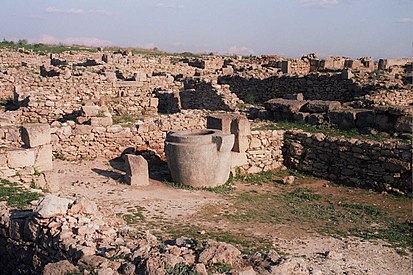
Ugarit was an ancient Canaanite city-state that rose to prominence around the 12th Century BCE.[6] In 1928 multiple stone tablets from between 1300-1200 BCE were discovered, and our understanding of Biblical history hasn’t been the same since.[7] These tablets detailed much about the pantheon of gods which were central to the religion of the area. El was the chief god, who created the world and ruled over all of the other gods; such as, Baal, Yam, Mot, Yahweh, and Asherah (El’s wife).[8] What’s most interesting about these texts is that many stories and acclamations regarding these deities are mirrored almost exactly in parts of the Old Testament, except their names were replaced with references to Yahweh in the Bible.[9] Clearly, this was an attempt by the Bible’s authors to simultaneously wipe out the history of the old gods, and prop up the last god standing: Yahweh.


Ä’l depicted with two lions
The Usurpation of El
Yahweh was originally a war god from southern Canaan who gained prominence when Saul, a follower of Yahweh, became the first king of Israel.[10] Given his position as the primary deity of the monarchy, Yahweh eventually superseded El as the king of the Gods and even became the consort of El’s wife, Asherah.[11][12] Given El’s previous importance, he left a significant mark on the language used by the Israelites in their holy scriptures. In the Bible, Yahweh is referred to as El, El Shaddai, El Elyon, and El Berith, and even the name “Israel” means “struggled with El.”[13]

The Shift to Monolotry
In much of the Old Testament, statements such as “Thou shalt have no other gods before me,” (Exodus 20:3) imply that the ancient authors weren’t opposed to the idea that other gods existed.[14] In fact, there was a point in ancient Israelite history where polytheism turned to monolotry, which comprises a belief in many gods, but the worship of only one.[15] It is not clear what led to this change, but it is very likely there were political motivations.[16] After all, it was King Josiah who outlawed the worship of other gods in 2 Kings 23, and Yahweh was the official god of the monarchy.[17] Thus, it is possible he did so in order to gain greater political control.

The Exile and Monotheism

It’s interesting to think that the ancient Jews believed polytheism led to their exile to Babylon, since it occurred only 12 years after King Josiah’s death, yet they needed an explanation.[18][19] During the battles with Babylon (and earlier Assyria), the political and religious elite believed that while Israel was weak, her god was the most powerful.[20] However, once defeated, the idea that Yahweh could be bested was not something they were willing to accept. Instead, they reasoned that Yahweh was the only god that had ever existed, and he helped the Babylonians defeat the Israelites as punishment for “playing the harlot” with other gods.[21] They also concluded that Yahweh willed them to return to Israel and enforce a purely monotheistic religion.[22] It was at this point that many portions of the Old Testament were written, such as Jeremiah, 2 Kings, 2 Chronicles, Ezra, Daniel, and the Book of Judith.[23] In fact, many scholars believe that a great deal of the Old Testament was compiled during and after the Babylonian Exile, which would account for the exclusion of Israel’s true polytheistic past in much of the Bible.[24]

Conclusion
Many followers of the Abrahamic religions believe their religion sprang from a unique tradition that could have only ever been inspired by the one true god. However, the ancient Israelite religion was not much different than that of the ancient Greeks or Egyptians. Yahweh was originally a god very similar in nature to the Greek god Ares, yet as the cultural climate changed, he was promoted to a more Zeus-like position. As time went on, and despite what the Bible says, cultural forces again changed his nature to become the sole-existent deity we know today. This is how the god of the Jews, Christians, Muslims, and Deists came about: it was simply a matter of cultural evolution.

Resources:

Fantastic video detailing the history of Israelite religion:

Great book about the cultural forces leading to Monolatry, Monotheism, Christianity, and Islam:

Great description of the Ugaritic Texts:

Wikipedia does a good job describing the history of Yahweh:


Cultural Evolution of Religion

As described in the previous three posts, evolution wired humans to be moral, to form supernatural beliefs, and to sustain those beliefs. Yet, we are not genetically predisposed to believe Jesus is the son of God or Muhammad spoke to the angel Gabriel. In other words, religious traditions are a product of cultural evolution, not biological evolution. As societies went from tribal to modern, and as cultures interacted with one another, supernatural beliefs and religious traditions morphed to better suit the needs of their host civilizations. As time went on, only the most useful religions were left standing.

Hamatsa Shaman. 1914.
Hunter Gatherer Religions
For hundreds of thousands of years, our ancestors lived in small bands hunting and gathering to survive. We can glean a sense of what their religious life might have been like by looking at the traditions of modern isolated tribes in places like Brazil, Africa, and New Guinea. These societies hold beliefs in invisible agents who are responsible for diseases, weather, and other natural events.[1] These agents tend to be quite amoral and whimsical, and most tribal societies don’t use them to inspire proper moral behavior.[2] Given that humans evolved to be cooperative and compassionate within small groups, these tribes tend to be good at maintaining social harmony on their own without religious inspired moral doctrines.[3] Another common element in these societies is the presence of an individual (e.g. a shaman) whose sole function is to communicate with these invisible agents to ask favors on the tribe’s behalf.[4] As the scholar Mircea Eliade wrote, “What is fundamental and universal is the shaman’s struggle against what we could call ‘the powers of evil.’ … It is consoling and comforting to know that a member of the community is able to see what is hidden and invisible to the rest and to bring back direct and reliable information from the supernatural worlds.”[5]

Religions of Chiefdoms and State Societies
While most hunter gatherer societies had very little political or religious organization, as they evolved to chiefdoms and state societies, politics and religion needed to become more sophisticated in order for these cultures to function.[6] Oftentimes, those who spoke on behalf of the gods ended up gaining political control of these societies.[7] They would use their special connection to the gods to legitimize their right to rule, and some would even claim to be gods themselves. For example, the pharaohs of ancient Egypt were believed to be gods, and many Roman emperors were also deified.[8][9] Since these societies tended to have far more than 150 constituents (the maximum size for a cohesive social unit,) formalized moral and ethical codes were essential for maintaining social harmony.[10] In addition, incorporating divine retribution for moral indiscretions was an effective way of ensuring citizens would follow the rules, even when no one was looking.[11] These divine laws were generally only applied to fellow adherents of any particular religion. Given that these larger societies were often in conflict with neighboring chiefdoms/states, religious intolerance was a useful way to inspire nationalism and motivate citizens to kill political/cultural enemies.[12] In short, as human civilizations became increasingly complex, religion functioned as a mechanism to maintain social harmony and to further the aims of the political elite.

Evolution of Mythology
As I define it, mythology encompasses the stories behind the gods, spirits, and/or agents who are venerated by a particular religious tradition. In the book When They Severed Earth from Sky: How the Human Mind Shapes Myth archaeologist Elizabeth Wayland Barber and her historian husband Paul T. Barber argued that these stories were the method by which ancient humans would transmit vital information over many generations.[13] As time went on, only a few elements of the original stories would remain, thus obfuscating their initial meanings. For example, what does a one-eyed monster that bellows from on top of a mountain and hurls boulders at people sound like? According to the Barbers, the original story of the Cyclops may have actually been a tale to warn people about the dangers of a volcano.[14] In ancient societies, this morphing of mythology became exacerbated as different cultures interacted with one another and merged. Oftentimes, the character of certain gods would change as the cultural contexts shifted. For example, Poseidon, the Greek god of the sea, was originally an Indo-European horse god that assimilated the qualities of several Near Eastern aquatic deities.[15] As the culture took on more of a seafaring role, his aquatic qualities overtook his original equestrian ones. Eventually, when Rome became the dominant culture of the west, they used Poseidon as the template for their own god Neptune.[16]

Survival of the Fittest Religion
The survivability of a religion depended on its ability to spread its message, to adapt to changes in cultural/historical contexts, and its compatibility with human psychology.[17] For example, some religions were successful because of their endorsement of militarism, they required members to have many children and proselytize to the masses, or because they promoted a worldview that was very comforting.[18] Ultimately, religions have to be infectious, persistent, and useful to the success of their host society in order to survive.

Conclusion
For many religious people, the fact that their religion survived while many others failed is proof that their god is the real God. However, all this really shows is that their religion was better at adapting, spreading, and surviving than other belief systems. For many spiritual but not religious types, the similarity between religions and the proliferation of supernatural beliefs are evidence that, as Cee Lo Green put it, “all religion’s true.”[19] What this really means is that all religions were created by humans for humans, and many stem from the same or similar cultural traditions.

Resources:

Great Lecture by Jared Diamond on the Evolution of Religions:

Good Article on the Survivability of Religions:

Great Book on Mythology:

Good Article on the Cultural Evolution of Religion: